
15%
growth identified in previously untapped catchment areas
What this article covers
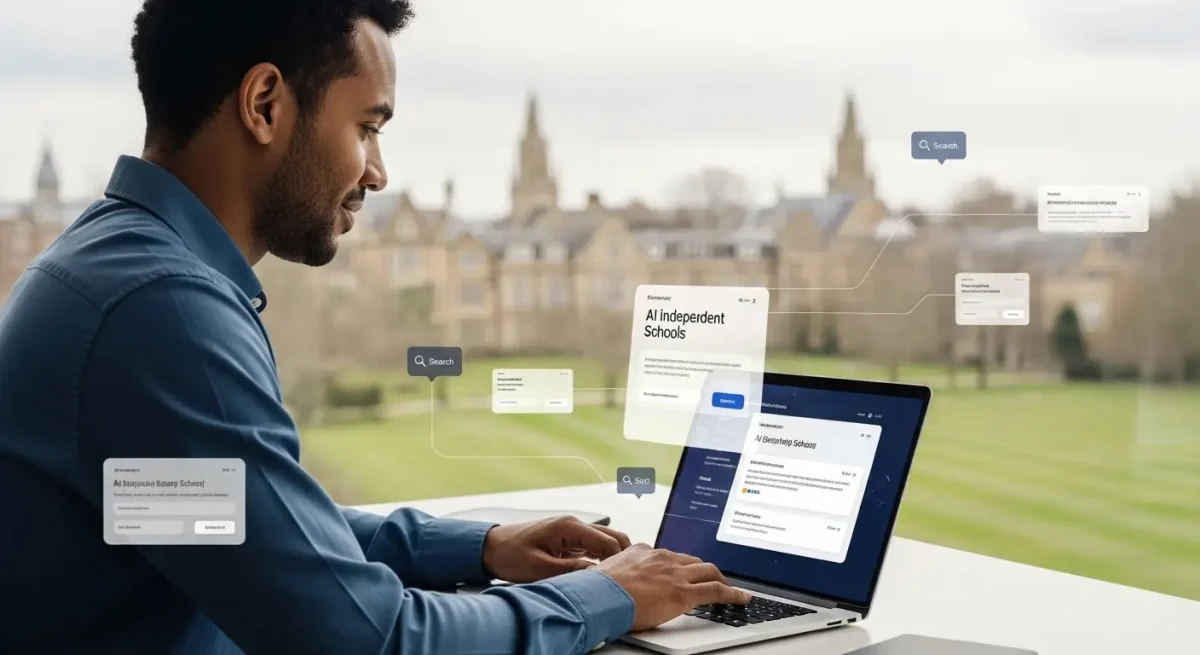
Artificial intelligence is already shaping how families research and choose schools. From first search to final enquiry, expectations around speed, clarity, and relevance have changed. For marketing and admissions teams, this creates both pressure and opportunity.
This article explores how AI can support the admissions pipeline in practical ways. Rather than focusing on tools, it looks at capabilities that help schools work more efficiently, communicate clearly, and respond effectively to prospective families.
This is not about replacing the human side of admissions. In a sector built on trust and safeguarding, AI should support good practice, not override it. The schools that benefit most will apply it thoughtfully, with clear boundaries and strong human oversight.
Why schools should think about AI in terms of capability, not tools
AI is often discussed in terms of tools. New platforms appear constantly, each promising transformation. For schools, this can feel overwhelming and unhelpful.
A better approach is to focus on capability. Where are the pressure points in your admissions journey? Which tasks take the most time? Where are delays or inconsistencies?
For example:
- how can we produce content more efficiently without losing quality?
- how can we respond to enquiries more quickly and consistently?
- how can we adapt existing materials without starting from scratch?
By focusing on outcomes rather than tools, schools can adopt AI in a measured, purposeful way.
This also protects what matters most. School marketing is not purely commercial. It requires sensitivity, accuracy, and trust. AI should support this work, not dilute it.
Where AI can support the admissions pipeline most effectively
AI becomes much easier to apply when viewed through the admissions journey.
At the top of the funnel, it supports content creation and visibility, helping schools answer real parent questions more effectively.
As families engage, it helps adapt and structure content across channels, ensuring consistency between website, email, and social.
At the enquiry stage, responsiveness becomes critical for maintaining momentum with prospective families. AI can support faster replies, more consistent follow-up, and better organisation of enquiries.
Further along the journey, it can support nurture through timely, relevant communication.
Finally, it can support insight and reporting, helping schools understand what is working and where enquiries are coming from.
Used this way, AI strengthens each stage of the pipeline while allowing teams to focus more on meaningful interactions with families.
Using AI to support content creation and repurposing
Content creation is one of the most immediate use cases for AI in school marketing. Teams are under pressure to produce blogs, emails, website pages, and campaign materials, often with limited resource.
AI helps reduce the time needed to get started. It can generate outlines, draft content, and suggest ways to repurpose existing material across formats. A single open day article can quickly become email content, social posts, and follow-up messaging.
This is not about replacing marketers. The real value lies in supporting early-stage production so teams can focus on tone, accuracy, and detail.
AI also improves consistency. By working from structured prompts or existing content, schools can reinforce key messages across multiple touchpoints.
A more detailed look at this balance can be seen in how AI can support school content without replacing human expertise.
Used well, AI enables more consistent, high-quality output without increasing workload.
Using AI to adapt imagery and video more safely and flexibly
Visual content is central to how schools present themselves, but it comes with challenges around cost, logistics, and safeguarding.
AI introduces flexibility.
Existing imagery can be enhanced, reformatted, and reused more effectively, reducing reliance on reshoots. This allows schools to get more value from their current assets.
It also supports safer use of imagery. Schools are increasingly cautious about using clearly identifiable images of children. AI can help adapt visuals to reduce identifiable detail while maintaining atmosphere and context.
Content can also be tailored more easily. The same image can be adapted for different audiences or campaigns without starting again.
Another benefit is the ability to create simple motion from still images, introducing more engaging formats without full video production.
Overall, this creates a more sustainable and flexible approach to visual content, allowing more work to be handled in-house.
As with written content, the key is responsible use. Visuals must remain authentic and representative of the school experience.
Example: from one image to multi-channel content
To illustrate how AI can support school marketing in practice, this example shows how a single image can be adapted and extended into multiple formats.
The starting point is a standard image used in marketing materials. While effective, it may have limitations in terms of flexibility, safeguarding, or suitability across different channels.
Using AI, the same image can be adjusted to reduce identifiable detail, making it more appropriate for wider use while still conveying the school’s environment and values.
From there, it can be transformed into short-form video content, allowing the same asset to be used across social media, landing pages, and digital campaigns without the need for additional filming.
This approach helps schools maximise the value of existing content, reduce production costs, and maintain greater control over how imagery is used across the admissions pipeline.

Original school marketing image used across multiple channels without adaptation

AI-adjusted version with reduced identifiable detail, adapted for broader and safer use
.gif)
Static image transformed into short-form video content to increase engagement across channels
Using AI to improve responsiveness and follow-up
The point of enquiry is critical in the admissions journey. Speed and quality of response can determine whether a family progresses.
AI can support both.
It can ensure enquiries are acknowledged quickly and consistently, reducing delays during busy periods. It can also help structure follow-up communication, keeping families engaged with relevant information.
Importantly, this does not replace human interaction. By reducing routine tasks, AI allows admissions teams to focus on meaningful conversations and personalised responses.
AI can also help prioritise enquiries based on behaviour and engagement, ensuring time is focused where it has the most impact.
A structured approach to this stage is central to conversion, which is why services such as admissions acceleration focus on both responsiveness and consistency.
Using AI to connect marketing performance with admissions outcomes
One of the biggest challenges in school marketing is understanding what drives enrolment. Many teams track activity but struggle to connect it to outcomes.
AI helps close that gap.
Working alongside CRM systems, it can connect marketing and admissions data into a clearer view of the pipeline. Instead of isolated metrics, schools can see how activity contributes to results.
For example:
- which campaigns generate high-quality enquiries
- which enquiries progress to visits
- which families convert to enrolment
This shifts focus away from surface metrics towards real performance.
AI can also support prioritisation, helping teams focus on enquiries most likely to progress.
For many schools, this is where the greatest value lies. Not more data, but better use of existing data.
Using AI to support insight, reporting, and decision-making
Many schools already have data, but lack clarity.
AI can summarise information, identify patterns, and highlight trends quickly. It helps teams understand which pages, campaigns, or channels are driving meaningful engagement.
This is particularly useful for smaller teams, reducing time spent on reporting and increasing time spent on decision-making.
It also supports a shift from activity-based reporting to outcome-based insight. Instead of focusing on clicks or traffic, schools can focus on what drives enquiries and enrolment.
Over time, this leads to more confident, evidence-based decisions.
Where schools need caution, judgement, and clear boundaries
AI must be used carefully in a school environment.
Data protection is critical. Sensitive information should not be entered into external platforms without proper controls.
Accuracy also matters. AI-generated content must be reviewed, particularly when it relates to admissions, fees, or pastoral care.
There is also a risk of over-automation. Not all interactions should be automated. Conversations with families require empathy and nuance.
Visual content must also remain authentic. AI should enhance, not misrepresent.
The most effective approach combines efficiency with strong oversight and a consistent human voice.
Common questions about AI in school marketing and admissions
Can AI replace a school marketing or admissions team?
No. AI is best used as a support tool, not a replacement. It can reduce time spent on repetitive tasks such as drafting content or organising data, but it cannot replicate the understanding, judgement, and personal interaction required in school admissions.
Is it safe to use AI in school marketing?
It can be, provided it is used responsibly. Schools need clear policies around data protection, content review, and safeguarding. Any use of AI should be treated with the same level of scrutiny as other external systems or suppliers.
Where does AI save the most time?
Typically in content production, reporting, and administrative tasks within the admissions process. Drafting content, summarising data, and structuring follow-up communication are all areas where AI can deliver immediate efficiency gains.
Do schools need expensive platforms to benefit from AI?
No. Many capabilities are already available within existing tools or low-cost platforms. The biggest gains often come from applying AI to existing workflows rather than investing in complex new systems.
What should always remain human-led?
High-value interactions with prospective families, including phone calls, meetings, and personalised responses. Strategic decisions, safeguarding considerations, and final content approval should also remain firmly human-led.
Why you can trust our approach
School marketing requires more than visibility. It requires attracting the right families and supporting them through to enrolment.
Our approach focuses on practical application, identifying where AI reduces pressure while improving outcomes. This includes content, enquiry handling, reporting, and campaign development.
Every school is different, so AI must support existing processes, not disrupt them.
Most importantly, we believe AI should enhance the human side of admissions, not replace it.
AI should reduce pressure, not increase risk
AI is already influencing how families discover schools. The question is how to use it effectively.
For most schools, the answer is to start with the areas under most pressure and apply AI in a controlled way.
Used well, AI improves efficiency, clarity, and communication.
Used poorly, it adds complexity and risk.
The opportunity is clear. AI should make admissions easier to manage, not harder to control.
Working with Lykke has improved how families find and engage with us. The uplift in enquiries and event attendance shows how much of a difference the right digital strategy can make
James Breeze, Director of Marketing and Admissions at QEH
By collaborating with Lykke on our digital approach, we have further optimised how families find and engage with us. The resultant increase in enquiries and event attendance demonstrates the efficacy of this partnership within our wider marketing plan.
James Leggett, Managing Director at MTM Consulting
- 10% growth potential in the school’s market share, focused on 3 main areas

How Lykke Education Uses AI in School Copywriting Without Losing Human Expertise
READ CASE SUDY ARTICLE - 10% growth potential in the school’s market share, focused on 3 main areas

How to Build an Independent School Website That Engages and Converts
READ CASE SUDY ARTICLE - 10% growth potential in the school’s market share, focused on 3 main areas

Why Paid Search is the Secret to Successful Open Day Sign-Ups for Independent Schools
READ CASE SUDY ARTICLE
Stay ahead with the latest in education
sign up for our newsletter to get industry news, insights, and case studies delivered to your inbox.
Sign Up for Our Newsletter